

Brushstrokes of Belonging: How Arts Shape Society and Society Shapes the Arts
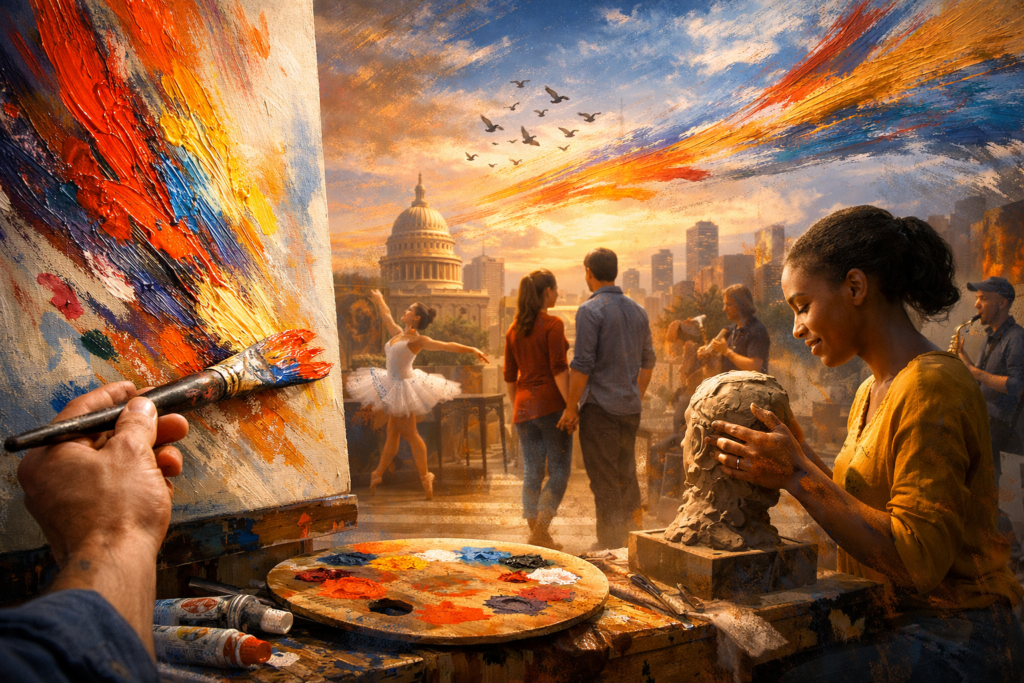
The Living Relationship Between Arts and Society
Arts and society are not separate worlds. Art is created by people embedded in particular histories, economies, cultures, and conflicts—and once shared, it feeds back into public life by influencing beliefs, aesthetics, and even policies. This relationship is dynamic: societies inspire themes, fund institutions, set boundaries of acceptability, and establish platforms for distribution; in turn, the arts offer a mirror, a megaphone, and a meeting place where communities negotiate meaning.
Whether through a protest song, a public mural, a film that reframes a historical moment, or a local theatre production that brings neighbors together, art helps society tell stories about itself—who “we” are, what we value, and what we’re willing to change.
What the Arts Do for Society
1) Reflect reality—and reveal what’s hidden
Some art documents lived experience with clarity: photography that captures working conditions, novels that depict migration, or documentaries that preserve testimonies. Other art reveals what’s harder to measure: anxiety in times of uncertainty, loneliness in hyperconnected cities, or the emotional cost of inequality. By making private feelings public, art expands what a society can recognize as real.
- Representation: People see themselves and their communities affirmed—or notice who is absent.
- Memory: Artistic works become cultural archives that outlast news cycles.
- Complexity: Art can hold contradictions where slogans fail, allowing nuance without losing urgency.
2) Challenge norms and redistribute attention
Arts can disrupt “common sense.” Satire exposes hypocrisy; experimental performance questions what counts as “normal”; street art can reclaim spaces dominated by advertising or surveillance. Even the choice of whose voice is centered is a political act. By redirecting attention toward marginalized experiences, the arts can shift social conversations—sometimes slowly, sometimes suddenly.
Historically, many art movements gained significance because they collided with the status quo. What was once dismissed as unruly—jazz, hip-hop, punk, modernist painting—often becomes a new mainstream language, changing how societies hear, see, and speak.
3) Build community and civic trust
Arts are social infrastructure. Choirs, dance groups, craft circles, poetry nights, and festivals create recurring rituals where people practice cooperation and shared identity. In diverse communities, these spaces can build “bridging” connections across age, class, and background. In communities under stress, cultural gatherings can restore a sense of continuity and belonging.
- Public art: Murals and installations can turn overlooked places into shared landmarks.
- Participatory arts: Community theatre and collaborative projects reduce the distance between “artists” and “audiences.”
- Intergenerational exchange: Traditions move from elders to youth through storytelling, music, and craft.
4) Contribute to education and empathy
The arts train interpretation: reading a poem teaches attention to language; learning an instrument teaches discipline, listening, and teamwork; analyzing a film teaches media literacy. These are civic skills. By inviting audiences into unfamiliar lives, art can strengthen empathy—not as a vague feeling, but as a practiced capacity to consider perspectives that differ from one’s own.
How Society Shapes the Arts
Institutions, funding, and gatekeeping
Artistic ecosystems rely on patrons, grants, venues, publishers, galleries, streaming services, and schools. These institutions can enable ambitious work, but they also shape what is considered “worthy” of support. When funding prioritizes prestige, artists may be pressured to match established tastes; when funding is cut, communities lose local stages where new voices emerge.
Gatekeeping is not only about money. It includes access to training, networks, and exposure. The question “Who gets to be an artist?” is often answered by social conditions—time, stability, and cultural permission.
Technology and the new public sphere
Technology changes both creation and distribution. Affordable tools have lowered barriers to entry: musicians can produce at home, filmmakers can shoot on phones, illustrators can publish online. At the same time, attention is concentrated on platforms with algorithms that reward speed, controversy, or familiarity.
- Democratization: More creators can reach audiences without traditional intermediaries.
- Precarity: Income can become unstable as metrics and trends shift quickly.
- Remix culture: Sampling, memes, and fan communities blur lines between producer and consumer.
Social movements and changing values
Movements for civil rights, gender equality, disability justice, environmental action, and decolonization have reshaped artistic priorities and institutions. They influence casting decisions, museum acquisitions, and which histories are taught. They also change audience expectations—demanding accountability, authenticity, and broader inclusion.
These shifts can be productive and contentious. Debates about cultural appropriation, censorship, and “cancelation” often reflect deeper questions: Who has the right to tell which stories? What responsibilities come with visibility? How should societies balance artistic freedom with harm reduction?
Arts, Identity, and Power
Art has always been intertwined with power. Rulers commission monuments; corporations sponsor cultural events; nations promote heritage to build legitimacy. But art also resists power by preserving counter-narratives. A folk song can carry banned history. A novel can expose state violence. A dance style can become a statement of survival.
Identity is similarly shaped through aesthetic choices. Clothing, design, language, and music signal belonging. These signals can be liberating—allowing communities to celebrate themselves—or restrictive, enforcing stereotypes. A healthy artistic culture makes room for self-definition rather than forcing communities into a single storyline.
The Economic and Urban Impact of the Arts
The arts generate jobs and attract tourism, but their economic role is complex. Cultural districts can revitalize neighborhoods, yet they can also contribute to rising rents and displacement when investment is not paired with protections for residents and local artists. Sustainable cultural policy considers both growth and equity.
- Creative labor: Many artists work across gigs; fair pay and contracts matter.
- Local ecosystems: Small venues, libraries, and community centers often support more experimentation than major institutions.
- Cultural planning: Affordable studios and rehearsal spaces can be as important as new flagship buildings.
Keeping the Arts Healthy in a Changing Society
For arts and society to enrich each other, participation must be possible, not symbolic. That means arts education that is not treated as optional, public spaces where culture can be shared safely, and funding models that recognize community value as well as commercial potential. It also means protecting artistic freedom while nurturing ethical dialogue about impact.
Ultimately, the arts are a way a society thinks in public. They help communities grieve and celebrate, argue and imagine. When societies invest in the arts—not only in grand institutions but also in everyday creativity—they invest in a more expressive, resilient, and connected civic life.